Research interviews provide valuable insights for academic studies, user research, and market analysis. However, turning hours of recorded conversations into organized, searchable text can be one of the most time-consuming parts of the research process.
Research interview transcription is the process of converting recorded interviews into written transcripts that researchers can review, analyze, and reference during their studies.
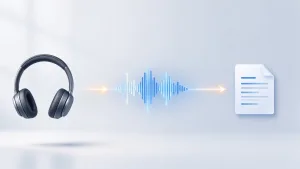
Traditionally, researchers listened to recordings and created transcripts manually. Today, AI transcription tools can help streamline this workflow by converting audio into searchable text, making interviews easier to review, analyze, and revisit.
This guide explains how to transcribe research interviews, compares different transcription approaches, and explores how AI transcription tools can support modern research workflows.
Why Is Research Interview Transcription Important?
Research interviews often contain detailed information that is difficult to analyze directly from audio recordings.
A well-organized transcript helps researchers:
- Review conversations faster
- Search for specific topics or quotes
- Compare responses across participants
- Identify recurring themes
- Create interview summaries
For qualitative research, transcripts often become the foundation for coding, annotation, thematic analysis, and reporting.
Researchers rarely review an interview transcript only once. During a research project, transcripts may be revisited multiple times to compare participant responses, validate findings, and support final conclusions.
Common Challenges When Transcribing Research Interviews
1. Manual Transcription Takes Significant Time
Manual transcription requires researchers to:
- Listen repeatedly to recordings
- Pause and replay sections
- Type conversations manually
- Review and correct mistakes
For projects involving dozens of interviews, this process can quickly become inefficient.
While manual transcription gives researchers complete control, it requires significant time and attention, especially when working with long recordings or multiple participants.
2. Long Interviews Are Difficult to Review
Research interviews can last one or more hours.
Finding a specific answer from a long recording often requires:
- Remembering approximate timestamps
- Searching through audio manually
- Reviewing the same sections multiple times
A searchable transcript makes it easier to revisit important parts of conversations.
Instead of listening through an entire recording again, researchers can search keywords, locate relevant sections, and review specific moments more efficiently.
3. Multiple Speakers Need Clear Organization
Research interviews usually include at least two participants:
- Researcher
- Interview participant
For group discussions, user research sessions, or panel interviews, transcripts may contain multiple voices.
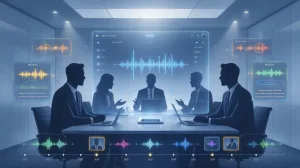
Speaker separation helps organize different parts of a conversation by speaker, making transcripts easier to review and analyze.
Clear speaker identification is especially useful when comparing responses across participants or analyzing conversational patterns.
4. Interview Data Becomes Difficult to Reuse
Research interviews often contain valuable information that may be needed months or even years after data collection.
Without searchable transcripts, researchers may spend significant time locating:
- Previous participant comments
- Important quotations
- Recurring themes
- Supporting evidence
Searchable transcripts help transform interview recordings into reusable research resources that can support future analysis and reporting.
How to Transcribe Research Interviews
There are three common approaches researchers use.
Method 1: Manual Interview Transcription
Manual transcription means listening to recordings and creating transcripts by hand.
Advantages
- Full control over formatting
- Useful for short interviews
- Allows researchers to review conversations closely
Limitations
- Requires significant time
- Difficult for large research projects
- Harder to maintain consistency across many interviews
Manual transcription may work well for small-scale studies but becomes challenging as interview volume increases.
Method 2: Professional Transcription Services
Some researchers use external transcription services to reduce manual workload.
Advantages
- Less manual work
- Human review may improve formatting
- Useful for specialized projects
Limitations
- Additional cost
- Requires sharing recordings with external providers
- Turnaround time varies
Professional transcription services may be preferred for projects requiring human verification, such as legal research, medical studies, court-related materials, or highly sensitive academic projects.
Researchers should consider project requirements, timeline, budget, and data handling preferences before choosing this approach.
Method 3: AI Research Interview Transcription
AI transcription tools use speech recognition technology to convert recorded interviews into text.
An AI-assisted workflow usually includes:
- Import interview recordings
- Generate a transcript
- Review and edit the transcript
- Organize research notes
- Extract important information
Modern AI transcription tools may support features such as:
- Searchable transcripts
- Timestamps
- Speaker separation
- AI-generated summaries
- Multiple language support
AI transcription can reduce the time required for the initial transcription process, while researchers remain responsible for reviewing important content and interpreting findings.
How Geode Supports Research Interview Transcription
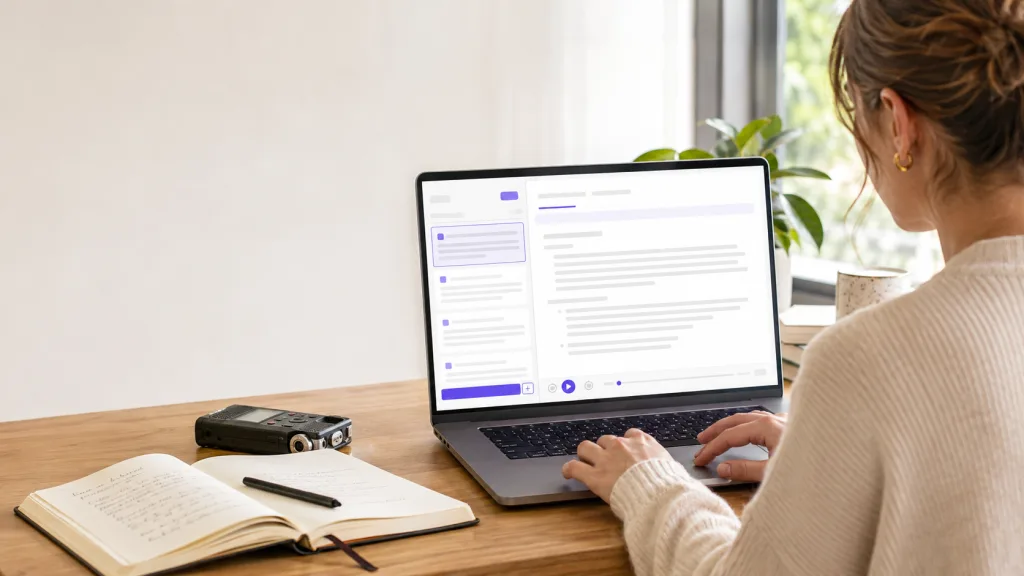
Geode is an AI transcription app that helps researchers turn interview recordings into searchable transcripts.
Researchers can use Geode to:
Convert Interview Recordings Into Searchable Text
Recorded conversations can be transformed into transcripts that are easier to review and analyze.
Instead of repeatedly listening through long recordings, researchers can search transcripts and quickly return to relevant sections.
This can be useful for:
- Research interviews
- User studies
- Academic projects
- Long-form conversations
Organize Conversations With Speaker Separation
Research interviews often include different participants.
Speaker separation helps organize different speakers within transcripts, making conversations easier to follow during review.
This is especially useful for:
- Research interviews
- User studies
- Long conversations
- Meeting recordings
Generate Interview Summaries
After creating transcripts, researchers can use AI summaries to quickly review key points and organize interview notes.
This can help with:
- Initial interview review
- Research preparation
- Identifying important discussion areas
On Mac, Geode supports local AI summaries. On iPhone, iPad, Android, and Windows, cloud AI summary options are available when needed.
Review Research Materials With More Control
Research recordings may contain unpublished findings, participant feedback, or internal research information.
Geode provides on-device transcription options, helping users maintain more control over their recordings during transcription workflows.
AI Transcription Workflow for Researchers
A practical workflow looks like this:
Step 1: Record Research Interviews
Use a recording device or app to capture conversations.
Common formats include:
- MP3
- WAV
- M4A
- MP4
Step 2: Import Recordings
Add recordings into your transcription workflow.
Organizing files by project, participant, and research stage can make later analysis easier.
Step 3: Create and Review Transcripts
Review the generated transcript and check important sections.
Researchers should always verify key quotes and findings before using them in final research outputs.
AI can accelerate transcription, but researcher judgment remains essential.
Step 4: Analyze and Organize Findings
Use transcripts to:
- Highlight important statements
- Compare participant feedback
- Create interview summaries
- Support qualitative analysis
In qualitative research, transcripts are often coded, annotated, and revisited multiple times during thematic analysis.
Best Practices for Research Interview Transcription
Use Consistent File Organization
A simple structure helps:
Research Project
├── Recordings
├── Transcripts
├── Notes
└── Analysis
Keep Speaker Information Organized
Clear speaker separation makes it easier to understand conversations and compare responses.
Review Important Sections
AI transcription can accelerate the workflow, but researchers should review important findings and quotations before using them in publications or reports.
Conclusion
Research interview transcription is an important step in turning recorded conversations into usable research data.
While manual transcription can work for small projects, AI transcription tools provide researchers with a faster way to create searchable transcripts, organize conversations, and review interview materials.
Researchers choosing an AI transcription workflow should consider factors beyond transcription speed, including searchability, speaker separation, organization, export options, and data handling preferences.
For researchers who value local processing and searchable transcripts, Geode is one option worth considering.
What is research interview transcription?
Research interview transcription is the process of converting recorded interviews into written text for analysis, documentation, and research purposes.
Can AI transcribe research interviews?
Yes. AI transcription tools can convert recorded interviews into searchable text, helping researchers review and analyze conversations more efficiently.
What is the best way to transcribe qualitative interviews?
The best approach depends on the project.
Manual transcription provides detailed control, while AI transcription tools can help researchers process larger numbers of interviews more efficiently.
Can AI separate different speakers in research interviews?
Yes. Some AI transcription tools support speaker separation, which helps organize different speakers within a transcript.
How long does it take to transcribe a research interview?
The time depends on recording length and transcription method.
Manual transcription may take several hours, while AI tools can create an initial transcript much faster.
Is AI transcription suitable for academic research?
AI transcription can support academic research workflows by helping researchers create searchable transcripts and organize interview data.
Researchers should review important content and verify quotations before using them in final publications.
Can research interviews be transcribed offline?
Some transcription tools support local processing, allowing users to create transcripts without relying entirely on cloud-based processing.
Can AI transcription be used for qualitative coding?
AI transcription can support qualitative research workflows by creating searchable transcripts that make coding and thematic analysis easier.
However, researchers should review transcripts and verify important interpretations before using them in final research outputs.