Today, AI transcription software can turn hours of audio into searchable text without waiting for a human transcriber. That changes the economics and speed of transcription, but it does not make human transcription irrelevant.
The better question is not whether AI or humans are better.
Which parts of the job actually require a human?
AI Transcription and Human Transcription Solve the Same Problem Differently
Traditional human transcription services send a recording to a professional transcriber, who listens to the audio and produces a transcript. Depending on the service, the transcript may go through additional review before delivery.
AI transcription software uses speech-recognition models to generate the first transcript automatically.
That creates a different workflow:
Human transcription: Audio -> Human transcriber -> Review -> Final transcript
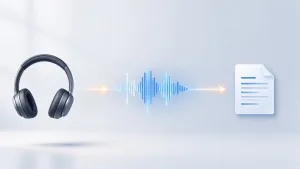
AI transcription: Audio -> AI transcript -> Your review -> Final transcript
The difference matters most in speed, cost, control, and who does the final checking.
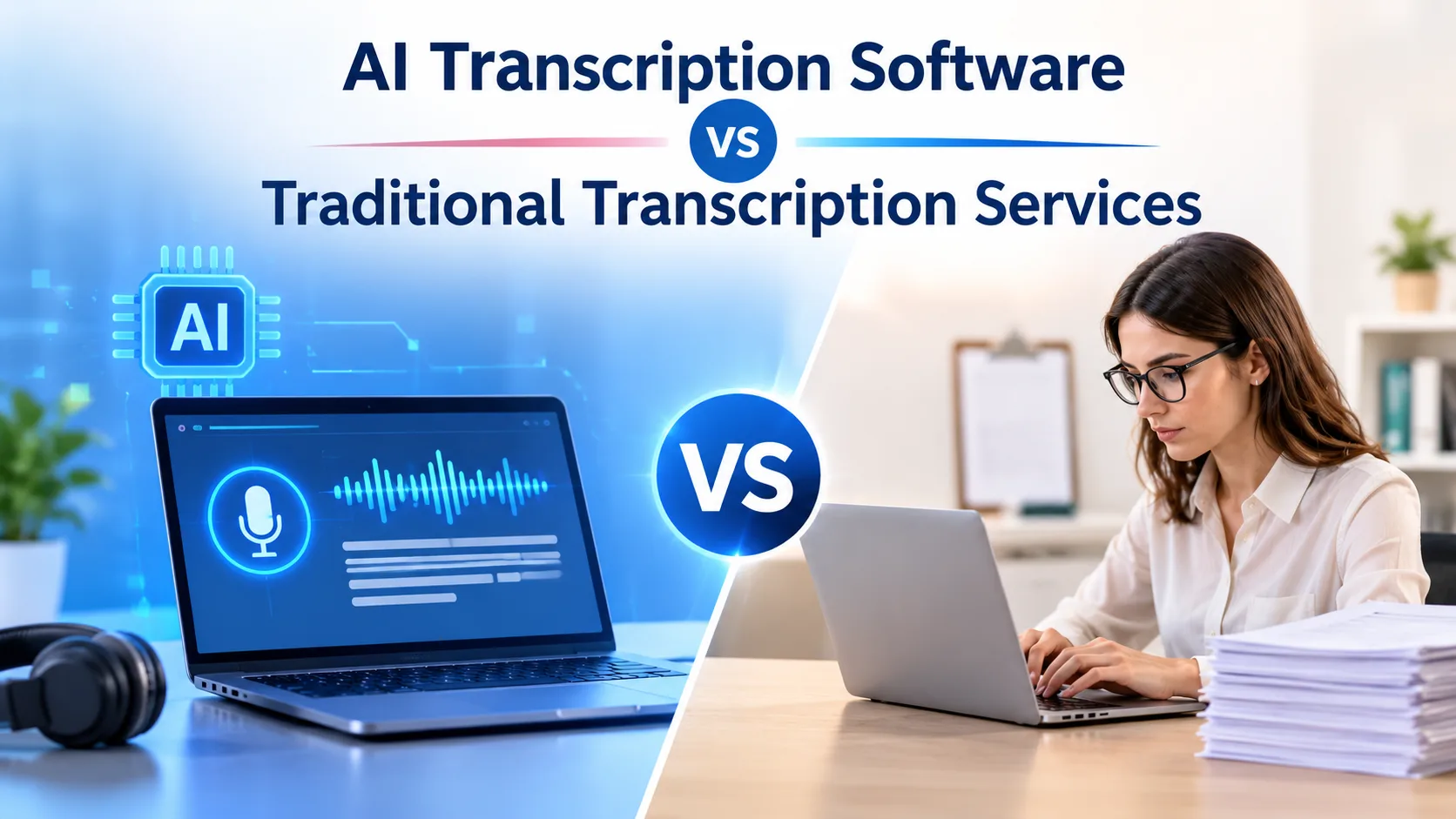
Automated vs Human Transcription
For most users, the practical comparison looks like this:
| AI transcription software | Human transcription services | |
| Turnaround | Usually fast | Usually slower |
| Cost at volume | Usually lower | Usually higher |
| Long recordings | Easy to process repeatedly | Cost grows with workload |
| Search and editing | Often built into the software | Depends on delivery format |
| Difficult audio | May require more review | Human judgment can help |
| Names and technical terms | Should be checked | Human review may improve them |
| Sensitive audio | Can remain local with some software | Recording normally has to be shared with the service |
| Final responsibility | User reviews important details | Depends on service and review level |
This is why automated vs human transcription is not simply an accuracy comparison.
It is also a workflow decision.
How Accurate Is AI Transcription?
There is no useful single number for AI transcription accuracy.
Results depend on the recording itself: microphone quality, background noise, accents, language, overlapping speech, specialized vocabulary, speaker distance, and the speech-recognition model all affect the transcript.
Clear audio with distinct speakers can produce very usable AI transcripts. Poor audio, crosstalk, unusual names, numbers, or technical terminology may require substantially more correction.
Human transcription has similar dependencies. A professional transcriber can use context to resolve ambiguous speech, but a human who does not know the subject can still mishear a name, acronym, or technical term.
So accuracy should not be treated as:
AI = inaccurate | Human = accurate
A better question is:
How much review does this recording require before I can rely on it?
Where AI Transcription Has the Advantage
AI transcription becomes particularly useful when transcription is frequent rather than exceptional.
A journalist may have several interviews to review. A researcher may accumulate dozens of recordings. A consultant may record meetings throughout the week. A student may want searchable transcripts from lectures.
Sending every recording to a human service adds both cost and delay.
AI transcription software changes that workflow because the first transcript can be generated immediately. You can search it, edit it, identify the sections that matter, and return to the original audio when something needs verification.
With Geode, transcription can run locally on supported iPhone, iPad, Mac, Android, and Windows devices. Desktop versions also support speaker separation, while supported Macs can generate Smart Summaries on-device. Optional cloud processing is available when users choose it.
For recurring transcription, that makes AI useful not only because it is faster, but because transcription becomes part of the recording and review workflow rather than a separate service request.
Where Human Transcription Still Makes Sense
There are situations where paying for human attention is reasonable.
If a recording is difficult to understand, contains highly specialized terminology, or must be delivered in a carefully controlled format, an experienced transcriber may save significant review time.
Human review can also be appropriate when the consequences of a transcription error are high.
That does not mean every word needs to be typed by a human from the beginning.
In many cases, the more efficient approach is to use AI for the first pass and reserve human effort for the material that actually requires it.
The Hybrid Approach Is Often More Practical
The choice does not have to be AI or human.
A practical workflow can be:
Record -> AI transcription -> Search and review -> Verify important sections -> Human review when necessary
This changes where human time is spent.
Instead of paying someone to transcribe two hours of clear audio from the beginning, AI can create the working transcript first. A journalist can then verify important quotations. A researcher can check passages used in analysis. A professional can review names, numbers, decisions, and technical terminology against the recording.
Geode is designed around this kind of review workflow. The original recording remains available alongside the transcript, and desktop tools support editing, speaker separation, search, and deeper review. Important names, numbers, technical terms, quotations, and speaker attribution should still be checked against the source audio when accuracy matters.
The goal is not to remove people from transcription.
It is to use human attention where it has the most value.
What About Sensitive Recordings?
There is another difference between software and a transcription service: where the recording goes.
A traditional transcription service generally needs access to the audio in order for someone else to transcribe it.
AI transcription does not necessarily require that.
Some AI transcription tools are cloud-based, but local transcription software can process speech directly on the user’s own device. Geode uses on-device transcription by default, with optional cloud transcription available when selected. Its local workflow can also operate offline on supported devices.
That can be useful for interviews, research recordings, internal conversations, and other audio where users prefer to reduce unnecessary cloud processing.
Local processing is not, by itself, a guarantee of legal, regulatory, or organizational compliance. Recording consent, storage, exports, backups, and the requirements of the specific workflow still matter.
Which Should You Choose?
Choose AI transcription software when:
- You transcribe frequently or have long recordings.
- Fast turnaround matters.
- You want searchable transcripts immediately.
- You are prepared to review important details.
- You want transcription integrated with recording, editing, summaries, or speaker separation.
- Local processing or offline transcription matters to your workflow.
Choose human transcription services when:
- The recording is unusually difficult.
- Specialized terminology requires substantial interpretation.
- You need a specific level of professional human review.
- The cost of an error justifies paying for more human attention.
For many workflows, the best answer is both:
AI for speed and scale. Human review for the details that matter.
Recording consent, storage, exports, backups, and the requirements of the specific workflow still matter.
Which Should You Choose?
Choose AI transcription software when:
- You transcribe frequently or have long recordings.
- Fast turnaround matters.
- You want searchable transcripts immediately.
- You are prepared to review important details.
- You want transcription integrated with recording, editing, summaries, or speaker separation.
- Local processing or offline transcription matters to your workflow.
Choose human transcription services when:
- The recording is unusually difficult.
- Specialized terminology requires substantial interpretation.
- You need a specific level of professional human review.
- The cost of an error justifies paying for more human attention.
For many workflows, the best answer is both:
AI for speed and scale. Human review for the details that matter.
Is AI transcription as accurate as human transcription?
LIt depends on the recording. Clear speech and good audio can produce highly usable AI transcripts, while background noise, overlapping speakers, names, numbers, accents, and specialized terminology can increase errors. Human transcribers can use context to resolve difficult passages, but human transcription is not error-free either.
Is AI transcription cheaper than human transcription services?
For frequent or long recordings, AI transcription is generally easier to scale because it reduces the amount of human labor required for every minute of audio. The actual cost depends on the software or service. Geode’s paid plans, for example, include unlimited local transcription rather than charging for each additional minute of local processing.
When should I use a human transcription service?
Human transcription is worth considering when audio is difficult, terminology is highly specialized, formatting requirements are demanding, or the consequences of an error justify additional professional review.
Should I review an AI-generated transcript?
Yes, when accuracy matters. Names, numbers, quotations, technical terminology, and speaker attribution are particularly worth checking against the original recording.
Can AI transcription keep recordings on my device?
Some software can. Geode performs transcription locally by default on supported devices, so the core transcription workflow does not require uploading audio to a transcription server. Optional cloud processing is available when the user chooses it.