This article is written for operational clarity, not legal advice. Organizations operating under GDPR should review workflow and technology decisions with their legal, compliance, and data protection leadership.
⸻
Zusammenfassung für Entscheidungsträger
Problemstellung:
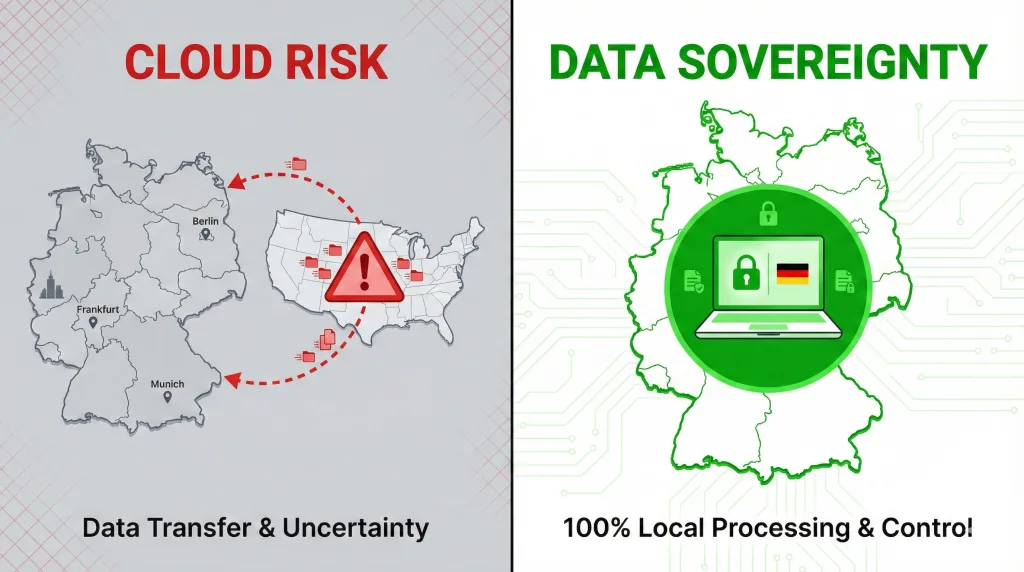
Cloud-basierte Transkriptionslösungen verarbeiten und speichern Gesprächsdaten häufig auf Servern außerhalb der EU, insbesondere in den USA. Spätestens seit dem Urteil Schrems II stellt dies für viele Unternehmen ein erhebliches Risiko im Hinblick auf die DSGVO-Compliance dar.
Risikoprofil:
Unklare Datenhoheit, potenzieller Zugriff durch außereuropäische Behörden sowie strukturelle Verstöße gegen die Prinzipien der Zweckbindung und der Datensparsamkeit.
Architektonischer Ansatz:
On-Device-Architekturen wie Geode verarbeiten Audio- und Textdaten vollständig lokal auf dem Mac. Es findet kein externer Datentransfer und keine cloudbasierte Weiterverarbeitung statt.
Fazit:
Für deutsche Unternehmen, insbesondere in regulierten oder mitbestimmungsintensiven Umfeldern, ist lokale Verarbeitung ein zentraler Baustein digitaler Souveränität und Risikominimierung.
In many German organizations, meeting transcripts are not treated as casual productivity artifacts—particularly when vendors promote their offerings as GDPR compliant transcription solutions.
They often contain:
- Personal data under GDPR (Art. 4)
- Employment-related discussions
- Strategic planning and internal decision-making
- Client or partner communications
- Context that may trigger heightened protection obligations under EU data protection law
As AI-powered meeting transcription tools become more common—including a wide range of cloud-based services marketed as GDPR compliant transcription—a growing number of German companies are asking a different kind of question, one that goes beyond selecting a secure transcription tool based on features alone:
Is cloud-based transcription compatible with our EU data residency and data sovereignty obligations under GDPR?
Increasingly, the answer is: not always.
This article explains why many German enterprises are reassessing cloud-based meeting transcription—and why discussions around GDPR compliant transcription often start with architecture, not features.
⸻
GDPR Changes the Question from “Who Uses the Data?” to “Where the Data Lives”
GDPR does not prohibit cloud computing.
But it does impose strict requirements around:
- Data minimization
- Purpose limitation
- Access control
- Cross-border data transfers
- Accountability for processors and subprocessors
In practice, this shifts the conversation away from:
“Is the vendor trustworthy?”
Toward:
“Can we clearly demonstrate where data is processed, stored, and accessed—at all times?”
For meeting transcription, this distinction is critical—especially when evaluating whether a GDPR compliant transcription workflow can withstand regulatory or audit scrutiny.
⸻
Risk 1: Cross-Border Processing Creates Structural Uncertainty
Many cloud-based transcription services rely on:
- Distributed infrastructure
- Multi-region processing
- Subprocessors outside the EU
- Complex data routing paths
Even when vendors offer EU-hosted options, organizations must still assess:
- Whether processing is strictly limited to the EU
- Whether support, maintenance, or operational access occurs elsewhere
- Whether data could be accessed under non-EU legal regimes
Under GDPR—and the implications of the Schrems II ruling—uncertainty itself is a risk.
For German companies, particularly those operating under close scrutiny from works councils (Betriebsräte) or data protection authorities, unclear data locality is often unacceptable, even if no incident occurs.
This position aligns with EDPB recommendations on supplementary measures for data transfers, which emphasize assessing not only contractual assurances, but the practical effectiveness of safeguards when personal data may be accessed from third countries.
⸻
Risk 2: Processor Chains Multiply Accountability
Cloud-based GDPR compliant transcription introduces multiple actors:
- The primary SaaS provider
- Infrastructure providers
- AI model operators
- Support and operational teams
- Potential subcontractors
Each additional processor expands:
- Documentation obligations
- Contractual dependencies
- Risk assessment scope
- Incident response complexity
GDPR’s accountability principle requires organizations not only to implement safeguards—but to demonstrate them.
As processor chains grow longer, that burden increases accordingly, complicating reliance on any centralized secure transcription tool that depends on external processing.
⸻
Risk 3: Access Surfaces Are Defined by Architecture, Not Policy
Cloud-based systems rely on:
- Role-based access controls
- Administrative privileges
- Support access procedures
- Policy enforcement mechanisms
These controls may be well-designed.
But they remain conditional.
From a GDPR perspective—particularly in Germany—regulators increasingly focus on:
- Whether access is technically possible
- Not just whether it is contractually restricted
Architectures based on local or on-device processing collapse access surfaces by design.
There is no external system in which access must be justified or audited—because data never leaves the organization’s control.
This architectural containment is one reason many German enterprises now evaluate GDPR compliant transcription approaches where processing remains local—treating transcription as a secure transcription tool embedded within managed endpoints and aligned with EU data residency expectations.
⸻
Risk 4: Data Gravity Conflicts with Purpose Limitation
Cloud transcription systems tend to accumulate:
- Audio recordings
- Transcripts
- Summaries
- Historical context tied to individuals and projects
Over time, this creates data gravity—the tendency for sensitive information to persist beyond its original purpose.
Under GDPR, purpose limitation and storage minimization (Datensparsamkeit) are not optional.
German data protection authorities have repeatedly emphasized that:
Data retained “just in case” is difficult to justify.
For organizations pursuing strict GDPR alignment, minimizing long-lived external data repositories is often a strategic choice—not a technical preference.
⸻
Why On-Device Architectures Are Gaining Attention in Germany
For some German companies, the response has been architectural.
Instead of asking:
“How do we govern access to cloud transcripts?”
They ask:
“Can we avoid creating external transcripts altogether?”
On-device approaches:
- Keep processing confined to local hardware
- Avoid cross-border data transfer questions
- Reduce processor-chain complexity
- Align technical reality with GDPR data minimization goals
For a detailed comparison of cloud-based versus on-device processing—especially regarding access surfaces—see:
Cloud AI vs. On-Device AI: Two Fundamentally Different Architectures
⸻
When Cloud-Based Transcription Still Makes Sense
This reassessment does not imply that cloud transcription is universally inappropriate.
Cloud-based workflows may be suitable when:
- Collaboration across distributed teams is essential
- Transcripts are intentionally shared and archived
- DPIAs support the model
- Processor relationships are clearly documented
The key distinction is intentionality.
German organizations increasingly reject default cloud adoption—not cloud technology itself.
⸻
The Takeaway: Data Sovereignty Is an Architectural Outcome
For many German enterprises, GDPR compliant transcription is not achieved through checklists.
It is achieved through structural decisions.
Meeting transcription workflows are evaluated based on:
- Where data is processed
- Where it can physically exist
- Who must be trusted for the system to function
Avoiding cloud-based meeting transcription is often less about fear—and more about control, clarity, and defensibility.
⸻
A Quiet Next Step
If your organization is evaluating how to capture meeting notes while maintaining strict EU data sovereignty, it may be useful to examine how on-device processing constrains exposure by design.
[Download: Pre-filled DPIA Argument for On-Device Transcription (PDF)]
[Download Geode for Mac] to evaluate a fully local transcription workflow that respects data boundaries by architecture.